
I have loved books for as long as I can remember, for their pictures, stories and knowledge and as beautiful and mysterious physical objects.
Like most children, it was the pictures that first caught my eye, and I was lucky to grow up in the 80s when children’s books still had hand drawn and hand painted illustrations as standard. One of my early memories is from when I was around four or five years old, copying artwork from a children’s book into a jotter.
A few years later, when I was nine or ten, a door-to-door salesman convinced my parents to buy a collection of educational books. I remember the boxes arriving and the excitement of opening them: a large dictionary and a series on technology and science, the human body, super-machines, space, the solar system etc. I loved them. They felt important and grown up and strangely magical, especially the dictionary which was the biggest book I had ever seen – and useful as I’ve never been good at spelling. Not long after that came my first magazine subscription, Airplane, with amazing issues dedicated to the F-14 Tomcat and the B-2 Stealth Bomber. These magzines had large pull-out posters for your bedroom wall and in-depth illustrations describing the onboard arsonal being carried, although, being a 10 year old boy, I lost interest when they moved from fighter jetairliners.
However, the period that truly cemented my love of books came during the summer I turned thirteen, when my family conveniently moved to live about two hundred yards from the local public library. This was the first time I was old enough to go and visit a library on my own. I had my own library card, complete independence, and now the confidence to move out of the children’s section to start exploring the teenage and young-adult shelves. It was there that I first encountered the horror genre, and three books left a permanent mark: Dracula by Bram Stoker, Jurassic Park by Michael Crichton and a third which was a book of short horror stories, whose title I no longer remember, and which I am still searching for. Dracula fascinated me with its unusual structure which was unlike anything I had read before. Jurassic Park did something else entirely. I had already seen the film in the cinema and loved it, but the book was on another level. It was the first time I truly understood that a book could surpass a film, even one I considered perfect. At the same time, I began collecting Street Fighter comics, which also became my first exposure to manga – it was a good summer for discovering new genres and artwork.
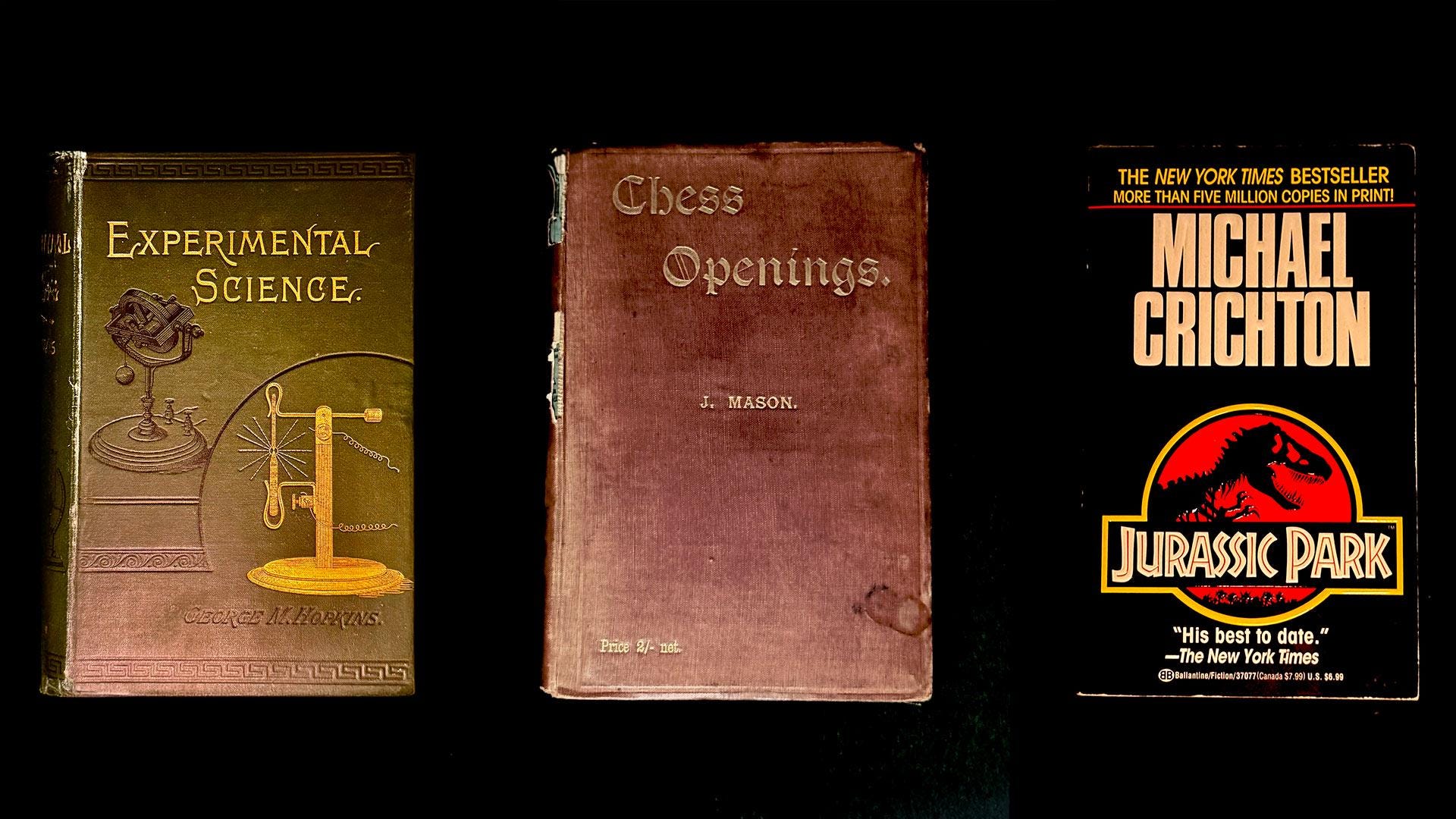
Despite all this, I had no real interest in antiquarian books until much later. In 2005, I moved from Belfast to Dublin and discovered a Sunday market in Blackrock which is where I bought my first antiquarian book: Experimental Science by George M. Hopkins, published in 1890. It was an impulse buy, but a significant one. Not long after, I bought Chess Openings by J. Mason (1897), and so then down the rabbit hole I went into the world of antiquarian books. Two of the most treasured volumes in my personal collection are my 1929 copy of The Three Musketeers published in New York by Dodd, Mead & Company and my 1809 Ackerman Repository Volume 1 Issues 1-6, both of which have wonderful colour illustrations and provide a fascinating portal into different historical periods.
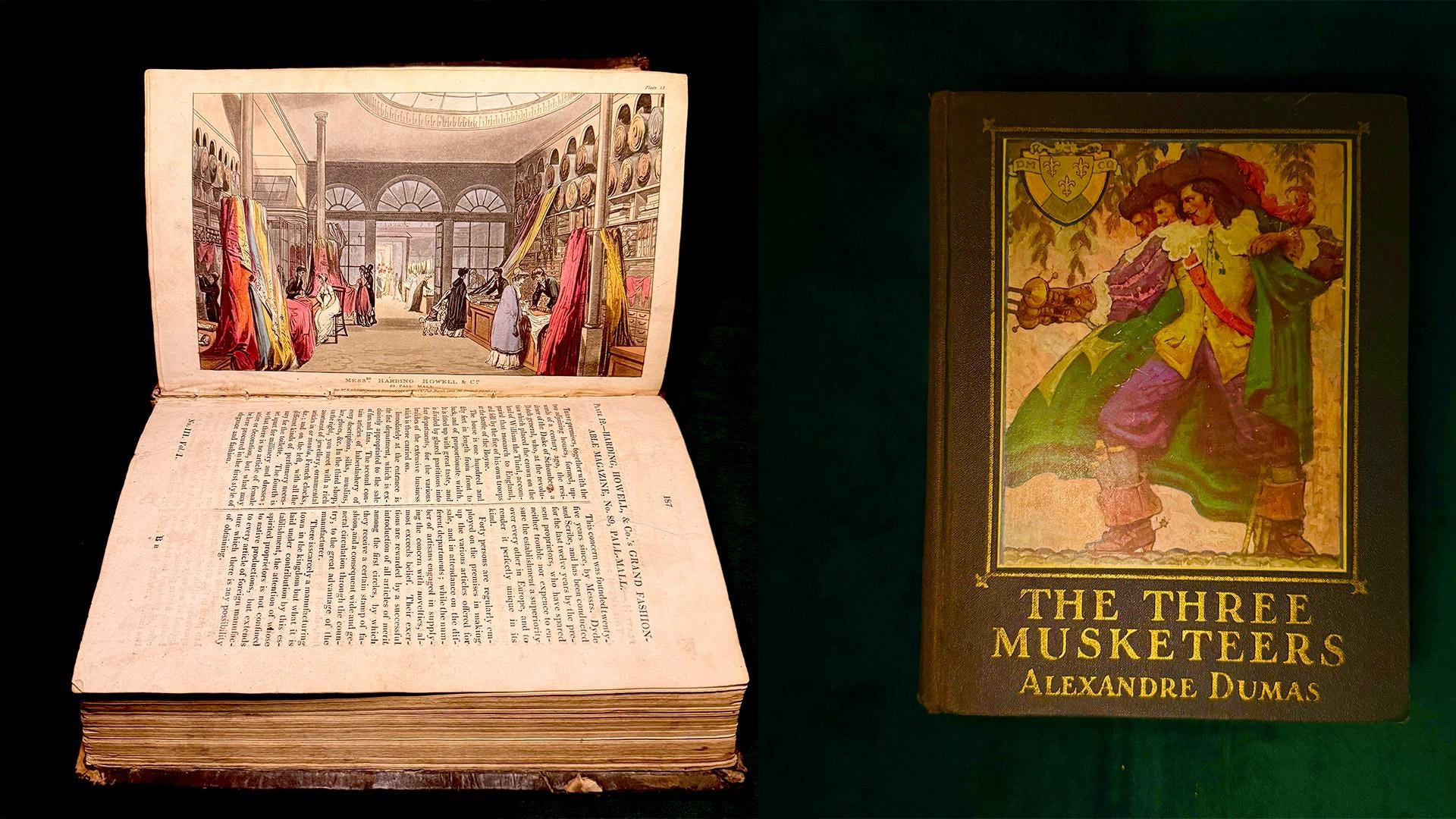
However, I don’t limit my collecting to antiquarian books. Some of the most difficult and rewarding items I’ve ever acquired are comparatively modern. One is Jurassic Park, not just any copy, but the exact edition I read for the first time as a twelve-year-old: the thirty-fifth printing from March 1993, with a specific cover design that had stayed with me for decades. Despite millions of copies being sold, that edition and cover art is surprisingly hard to find. After a long search, I eventually tracked one down in Germany. Another is Street Fighter II Turbo by Will Evans, a novelisation that was given away with the 90s UK Super Nintendo magazine SNES Force. It provided background stories for the characters in the game and was never sold commercially as a stand-alone title. In all the time I searched for it, I only ever saw one copy appear on the market - it now sits proudly in my collection.
Collecting books, like collecting anything, is deeply personal. What one person values may seem obscure, unnecessary, or even absurd to another. But value has never been purely rational. Whether it’s a Pokémon card, a medieval Bible, a first edition Harry Potter, or a comic book that once cost just a few coins and now costs quite a few more, objects gather meaning through time, scarcity, memory, and desire.
For me, books have a sort of magical presence and the ability to capture memory in the same way all great art can. That belief sits at the heart of this site. Everything here is chosen carefully, whether it is a nineteenth-century scientific volume, a piece of popular culture, or a book tied to personal nostalgia. The aim is not simply to sell books, but to curate objects that deserve to be owned, handled, read and kept for both personal enjoyment and for future generations.